
UNDERSTANDING SUPPORT AT HOME FEES and COSTS.
From November 1st 2025, the Support at Home program will commence. This replaces home care packages and short term restorative care aiming to create an easier system for in home aged care.
This page will address how your funding works and what costs will be involved.
Your Funding
Your funding category will be set through an aged care assessment.
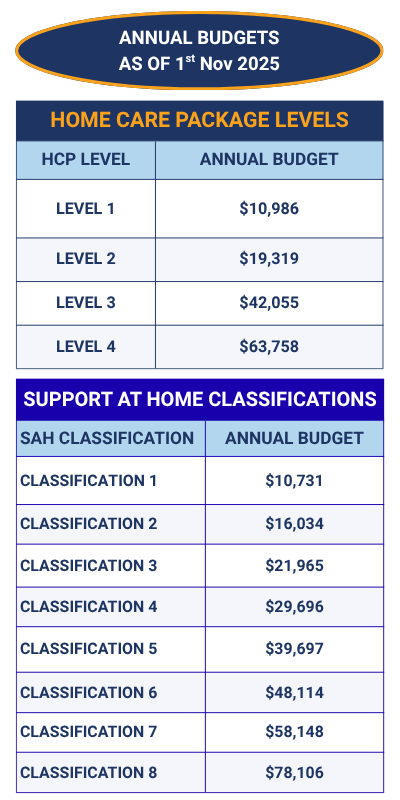
The current Home Care Package program has four levels of funding.
The Support at Home program will have eight funding classifications, with the annual budget allocated in quarterly amounts.
Unspent Funds
If you are an existing home care package receiver (grandfathered), you will retain all of your unspent funds. They will carry over into Support at Home where they will be available to use.
Under the Support At Home program, you can carry over up to $1000 or 10% of your quarterly budget (whatever is greater) into your next quarter.
If your quarterly budget is exhausted, you can use your HCP balance to
pay for approved Support at Home services
purchase assistive technology or home modifications to meet your assessed needs.
Support at Home Services
SAH Services fall into 3 different categories: Clinical Supports, Independence and Everyday Living.
Clinical Supports
Nursing, Allied Health, Therapies and Medication Support
Independence
Personal assistance, Continence, Mobility, Respite, Social Support and Transport
Everyday Living
Cleaning, Laundry, Meals, Gardening and Home Maintenance
The government pays the full cost of Clinical Supports, however you may need to pay contributions for Independence and Everyday Living services. This will be based on your pension or income status.
Contributions
Full Pensioners: You will need to contribute 5% for Independence Services and 17.5% of the cost of Everyday Living Services
Part Pensioners: Dependent on your income and assets, you will contribute between 5% to 50% of the cost of Independence Services and between 17.5% to 80% for the cost of Everyday Living Services
Self Funded Retirees: You will contribute 50% of the cost of Independence Services and 80% for the cost of Everyday Living Services
If you are struggling to afford your contribution, you can apply for financial hardship assistance to ensure no interruption to your care.

Types of Participants
After the 1st of November 2025, anyone receiving or applying for home care support will be entered into the Support At Home Program.
There are 3 groups which they will fall into, dependent on when they were first approved.
Grandfathered Participants
If you were approved on, or before the 12th of September 2024. Your contribution arrangements will be protected by the No Worse Off rule. You will pay the same as before, or less.
Transitioned Participants
If you were approved after the 12th of September 2024, but before the 1st of November 2025. You will transition to the Support at Home program on the new contribution settings. This is determined by you income or pension status.
New Entrants
If you were approved on, or after the 1st of November 2025. You will start under the Support At Home rules.
Care Providers are now only allowed to charge 10% Care Management fees under Support At Home.
The Government has advised Care Providers to increase their hourly rates to recover the loss of income from the previous management fees charged under the home care package program.